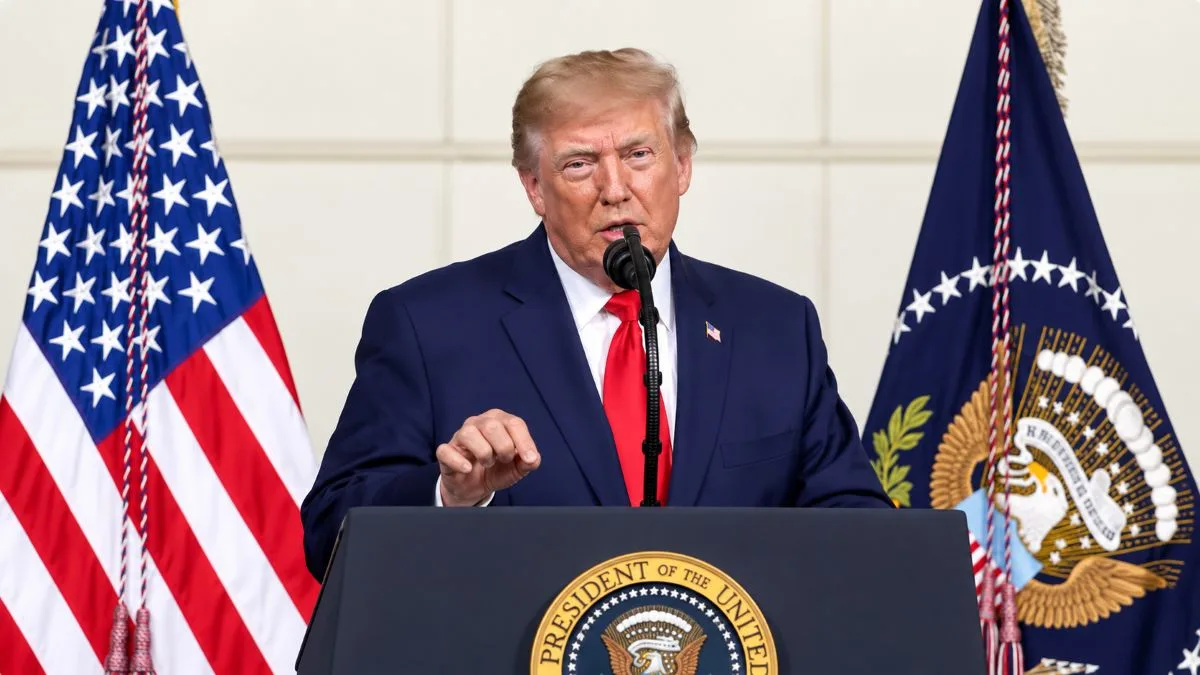
Donald Trump spent much of the year trying to solve one of the Republican Party’s most persistent problems: millions of voters will show up for him in ways they do not reliably show up for other Republicans.
The solution was audacious. Make a midterm election feel like another Trump election.
That was the strategic purpose of September’s unusual Republican convention in Dallas, a two-night spectacle with no presidential nomination to conduct and no traditional convention business to resolve. Trump put himself at the center, asked voters to treat November as a personal favor to him and tried to transfer the emotional force of his political brand to Republican candidates around the country.
Weeks later, Republicans are getting an uncomfortable look at the other side of that transaction.
Ken Paxton, the Trump-backed Republican Senate candidate in Texas, reportedly told donors that his numbers and those of other Republicans fell after the convention. Trump’s approval has dropped to roughly one-third in Reuters/Ipsos polling. High living costs and the war with Iran have weakened the president’s standing, while Republicans are spending heavily even in places they once expected to dominate.
The party still needs Trump.
The question is whether some candidates now need protection from the election becoming too much about him.
Dallas Was an Attempt to Transfer a Personal Coalition
Trump’s political strength has never been identical to generic Republican strength.
He commands an audience that is intensely loyal, highly responsive to his endorsements and unusually motivated by his personal grievances and victories. That relationship has repeatedly created a turnout problem when his name is absent from the ballot.
The Dallas convention was designed to close that gap.
Trump and Vice President JD Vance framed the midterms as a test of whether voters would preserve the movement’s power in Congress. The event showcased Trump-backed candidates, his legislative priorities and the argument that electing Republicans was effectively another way to vote for the president.
That theory depends on one assumption: that Trump’s personal appeal is more transferable than his personal unpopularity.
The final month of the campaign will answer that.
THE INSIDE READ
Republicans are not really debating whether Trump is good or bad for the party in the abstract.
They are trying to solve a harder mathematical problem.
How much Trump is enough?
A Republican candidate cannot easily reject the president when Trump controls the attention of the base, commands the party’s largest political megaphone and is backed by an enormous fundraising apparatus through groups such as MAGA Inc.
But a candidate in a competitive race also has to win voters who do not experience Trump as a source of energy. Some see him as the source of their economic frustration, foreign-policy anxiety or exhaustion with political conflict.
That means the ideal amount of Trump is different in Texas, Michigan, Maine, Kansas and suburban House districts.
The convention tried to create one national answer.
The campaign map is now forcing Republicans back toward many local answers.
Paxton’s Reported Comment Matters Because He Is Not a Never-Trumper
The most politically interesting criticism did not come from a moderate Republican trying to distance himself from the president.
It came from Paxton, a candidate who benefited from Trump’s endorsement and remains supported by Trump-aligned money.
The New York Times reported, and Reuters summarized, that Paxton told a private gathering that Republican numbers fell after the Dallas convention. His adviser disputed the characterization of the remarks, and Reuters did not independently verify the recording.
That caveat matters.
So does the existence of the conversation.
If even a deeply Trump-aligned campaign is privately measuring whether Trump-heavy events create drag, then Republican strategists are no longer dealing with a theoretical concern. They are trying to price the president into specific races.
Trump Is Responding by Campaigning More, Not Less
The White House’s answer has been to intensify the president’s involvement.
Trump has launched a final-month campaign blitz, including appearances in heavily Republican territory where the party is trying to shore up enthusiasm. That is an important clue.
A president with overwhelming political strength would usually spend precious time in true battlegrounds expanding the map.
Spending significant energy in reliably Republican areas suggests the party is also worried about motivation inside its own coalition.
Trump’s team can reasonably argue that no Republican figure can mobilize those voters better.
But that same dependence makes it difficult for candidates to establish an identity separate from a president whose approval is weak.
The Money Advantage Does Not Solve the Message Problem
Republicans have access to enormous sums of campaign money, including hundreds of millions held or spent by Trump-aligned organizations.
Money can buy advertisements, turnout operations, data and staff.
It cannot make voters care about the issue a campaign wants them to care about.
Republicans would prefer to talk about border enforcement, taxes, crime and Democratic governance. Many voters continue to focus on prices, energy costs and the Iran war.
That mismatch helps explain why Trump keeps returning to the campaign trail: the party is trying to use his personal connection with supporters to overpower a less favorable issue environment.
THE SIGNAL
Watch where Trump does not go.
Campaigns reveal their fears through scheduling. If Republicans eagerly bring Trump into a district, they believe his turnout value exceeds his downside there. If a candidate praises him but avoids a joint appearance, that is a different calculation.
Also watch advertising language. Candidates who use Trump heavily in fundraising emails but barely mention him in general-election television spots are telling you exactly which electorate they are trying to satisfy at each stage.
WHAT HAPPENS NEXT
Trump will continue campaigning aggressively through November 3 because the White House has little incentive to retreat from a strategy built around his personal brand.
Republican outside groups will keep spending heavily in races that have become more competitive than expected.
And candidates will increasingly localize their closing arguments, even while the president tries to nationalize the election around himself.
THE INSIDER BOTTOM LINE
Trump’s midterm strategy was built on a powerful truth: the Republican Party still does not have a better tool for activating Trump voters than Donald Trump.
The problem is that those voters are only part of the electorate. The final month will test whether the president can transfer his political intensity without transferring all of his political baggage with it.
Leave a Reply