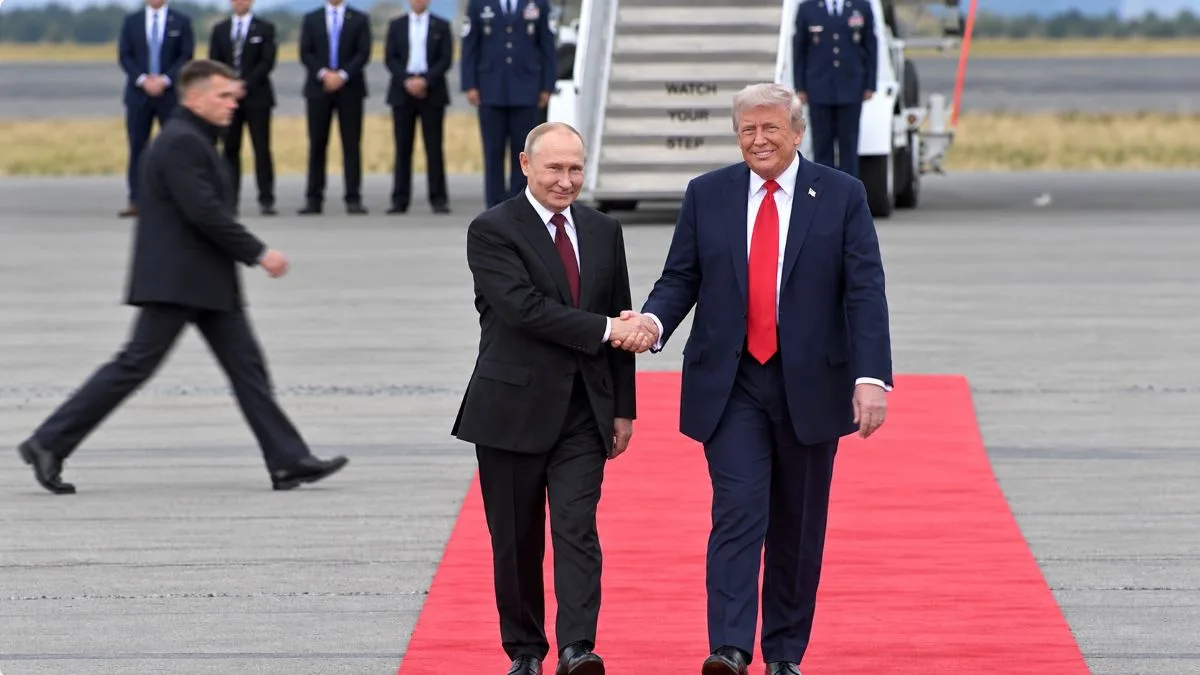
For a few hours, diplomacy appeared to have created something increasingly rare in Ukraine: space.
Then the war returned.
U.S. envoys Steve Witkoff and Jared Kushner traveled through Moscow and Kyiv over the weekend, holding extended talks with Russian President Vladimir Putin and Ukrainian President Volodymyr Zelenskyy as the Trump administration attempted to restart negotiations over a conflict now in its fifth year.
The meetings produced no breakthrough. But Zelenskyy offered a cautiously positive assessment, saying the American side had presented several worthwhile ideas that Kyiv was prepared to explore further with Washington and European partners.
That was the hopeful part.
Then Russian missiles and drones began hitting Kyiv again.
A major wave of attacks on Tuesday killed five people and injured more than 30 after a brief halt in near-constant strikes during the U.S. envoys’ visit. Russian drones struck again early Wednesday, hitting Kyiv and a border crossing in the Odesa region near Moldova, where two civilians were killed.
There is no public evidence that Putin personally ordered the pause or the renewed strikes as a negotiating signal.
But the sequence captures the central reality facing Trump’s peace effort.
Diplomacy has not replaced coercion.
It is occurring inside it.
Moscow Has Little Reason to Give Away Leverage
Peace negotiations are usually described as an alternative to war.
For the Kremlin, they can also be another arena in the same contest.
Russia controls territory. Ukraine controls territory Moscow claims. Both sides understand that the military situation affects what each can demand at a negotiating table.
That makes battlefield pressure politically valuable even while envoys are moving between capitals.
Ukraine and Russia remain divided over fundamental questions, particularly the Donbas, parts of which remain under Ukrainian control despite Moscow’s claim to the region.
Trump’s diplomats can present formulas, guarantees and potential compromises.
They cannot wish away the question underneath every proposal:
Who has enough leverage to force the other side to accept it?
THE INSIDE READ
Putin’s strongest negotiating position may be one in which Washington believes a deal is possible while Kyiv simultaneously believes the alternative to compromise could be worse.
Those incentives are not contradictory.
If Russia rejected every diplomatic approach immediately, Trump could conclude that Moscow has no interest in negotiation at all.
If Russia stopped applying military pressure, however, it could surrender one of its strongest tools for extracting concessions.
The more effective strategy from Moscow’s perspective may be to remain engaged enough to keep Trump invested while continuing enough military pressure to make Ukrainian resistance expensive.
That interpretation cannot be proved from the timing of this week’s attacks alone.
But it explains why encouraging diplomatic language and deadly battlefield action can coexist without representing a fundamental change in Russian strategy.
Zelenskyy Has His Own Constraint
Ukraine cannot negotiate purely around what Trump or Putin wants.
Zelenskyy must consider what Ukrainian society, the military and the country’s European supporters can accept after years of invasion, destruction and territorial loss.
He described some of the American ideas positively but declined to disclose them, saying the parties had agreed to work through them first.
He also said Ukrainian, American and European representatives would prepare for a future trilateral format and suggested that issues such as grain shipments, energy infrastructure and prisoner exchanges could form part of the process.
Those are areas where incremental agreements may be possible.
Territory is harder.
A compromise that appears reasonable to an outside mediator can be politically explosive inside a country being asked to relinquish land it considers its own.
That means Trump is not simply trying to persuade Putin to stop.
He is trying to find a settlement both Putin and Zelenskyy can survive politically.
Trump Needs More Than Another Meeting
Trump has repeatedly sought to present himself as the leader capable of ending wars through direct bargaining and pressure.
That creates its own deadline.
Another summit without movement would generate headlines but not a settlement.
Another temporary reduction in attacks would be useful but reversible.
Another prisoner exchange would matter to the families involved while still leaving the basic conflict intact.
The test is whether the renewed U.S. process begins producing commitments that are expensive for either side to reverse.
Until then, diplomacy remains provisional.
THE SIGNAL
The most important signal may be what Russia does before, during and immediately after the next diplomatic meeting.
This week’s pause followed by renewed strikes does not prove a coordinated message.
But if the pattern repeats — military restraint around negotiations followed by escalation when pressure is needed — it would offer a clearer window into Moscow’s negotiating method.
Also watch air-defense discussions.
Zelenskyy says he plans to speak with Trump later in September about additional winter air-defense support. If Washington increases Ukraine’s defensive capacity while simultaneously pressing for a deal, the United States would be using its own version of leverage rather than diplomacy alone.
WHAT HAPPENS NEXT
The first development to watch is preparation for another trilateral diplomatic round involving Ukraine, the United States and Russia.
The second is whether European governments are brought more directly into shaping the proposed framework.
The third is military. If Russian attacks continue at high intensity while talks advance, it will become increasingly difficult to portray the diplomacy as a conventional de-escalation process.
It may instead be negotiation under fire.
THE INSIDER BOTTOM LINE
Trump’s peace effort has reopened a diplomatic door that had been largely stuck.
Putin has not walked through it.
For now, Russia appears willing to discuss what peace could look like while preserving the military pressure that may help determine whose version of peace ultimately reaches the table.
Leave a Reply