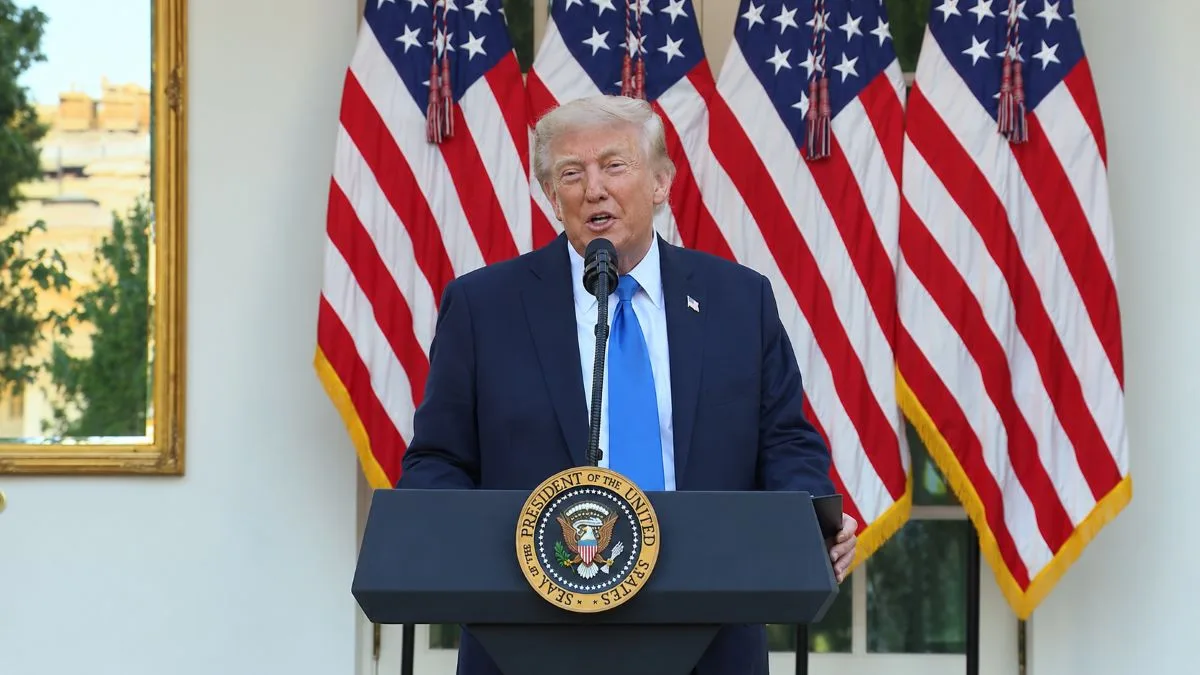
Donald Trump has given Republican voters a remarkably direct instruction ahead of November’s midterm elections: behave as though he is personally on the ballot.
The Republican Party is now building an entire political spectacle around that idea.
A two-day convention in Dallas will place Trump at the center of the GOP’s final sprint toward Election Day, an unusual undertaking for a midterm year when parties normally leave their candidates to fight district by district and state by state.
Trump is scheduled to address the gathering on both days. Vice President JD Vance, cabinet officials, congressional leaders and candidates from competitive races are also expected to appear. Organizers are trying to produce something closer to the energy of a presidential nominating convention — without a presidential nomination to award.
The strategic theory is straightforward.
Trump can generate attention. Trump can generate turnout. Trump can dominate television, social media and political conversation in ways few Republicans can replicate.
The risk is equally obvious.
Trump is not actually on the ballot.
The Party Is Betting on Transferable Political Power
Presidents almost always loom over midterm elections, particularly when their party controls Washington.
But Trump’s relationship with Republican voters is different from that of a conventional president.
His supporters have repeatedly demonstrated intense loyalty to him personally. The challenge for Republican strategists has always been converting that attachment into votes for candidates named Smith, Jones or Paxton when Trump himself is not standing at the top of the ballot.
Dallas is effectively an experiment in political transfer.
Can Trump lend his emotional connection with the Republican base to dozens of congressional and statewide candidates?
Or does making the election a referendum on Trump create exactly the nationalized environment Democrats want?
Reuters/Ipsos polling puts Trump’s approval at approximately 33%, the lowest level of his second term, amid concerns over living costs, the economy and the Iran war. Some Republicans in tight races are expected to remain in their districts rather than attend the convention. House Speaker Mike Johnson has publicly acknowledged that many lawmakers need to keep campaigning at home.
That split tells its own story.
THE INSIDE READ
Republicans are dealing with two electorates at once.
The first is the Trump electorate: highly motivated voters who may respond to the president’s warnings, endorsements and attacks with the same intensity they showed when his own name appeared on the ballot.
The second is everyone else.
That includes independents, less ideological Republicans, suburban voters, occasional voters and people whose political mood is being shaped more by prices and economic anxiety than by loyalty to either party.
Trump may be uniquely capable of energizing the first group while simultaneously making the second harder to win.
That is the tension sitting underneath the balloons, speeches and entertainment in Dallas.
The party does not have an obvious substitute for Trump’s ability to command its base. But every candidate who embraces him also inherits some portion of his national political baggage.
Watch the Candidates Who Stay Home
The most revealing Republicans this week may not be the ones standing on stage.
They may be the ones who are missing.
More than 100 Republican House members and candidates were expected to participate, while several candidates in competitive contests were uncertain about attending. Trump-aligned political organizations also possess enormous resources and have begun deploying money into important races.
Money and presidential attention are difficult for candidates to reject.
So is local political reality.
A Republican running in a deeply conservative district has little reason to hide from Trump.
A Republican fighting for suburban swing voters may conduct a different calculation.
That divergence will become more important as early voting approaches.
Dallas Is Also About Control of the Party
There is another layer to this convention.
Trump is not simply campaigning for Republicans. He is demonstrating ownership of the Republican political machine.
Candidate endorsements, speaking slots, money, messaging and the national stage all flow through a party that remains deeply organized around him.
The Texas Senate race offers a particularly revealing example. Trump backed Ken Paxton over incumbent Republican Senator John Cornyn, and Paxton is now one of the candidates being showcased during the convention.
That sends a message beyond Texas.
Trump’s power is not limited to defeating Democrats. It still shapes which Republicans get to represent the party in the first place.
THE SIGNAL
Watch how candidates in genuinely competitive races use Trump after the convention.
Do they flood their advertisements with footage from Dallas?
Do they campaign on Trump’s record?
Do they mention him selectively?
Or do they quietly return home and make the election about local prices, jobs, schools, crime and their Democratic opponents?
The answer will tell us what Republican internal polling is really saying.
Campaign behavior often reveals political reality before public rhetoric does.
WHAT HAPPENS NEXT
The first test is enthusiasm. If Dallas generates substantial Republican attention and fundraising, the White House will argue that the event proves Trump remains the party’s strongest mobilizer.
The second test is polling in competitive states and districts.
The third arrives in November: whether Trump can reproduce presidential-year loyalty for candidates who do not have his name, celebrity or relationship with the Republican base.
THE INSIDER BOTTOM LINE
Donald Trump wants the Republican Party to convince voters that voting GOP in November is effectively another vote for him.
That may be the party’s strongest turnout argument.
It may also be exactly the referendum Democrats hope to run.
Leave a Reply