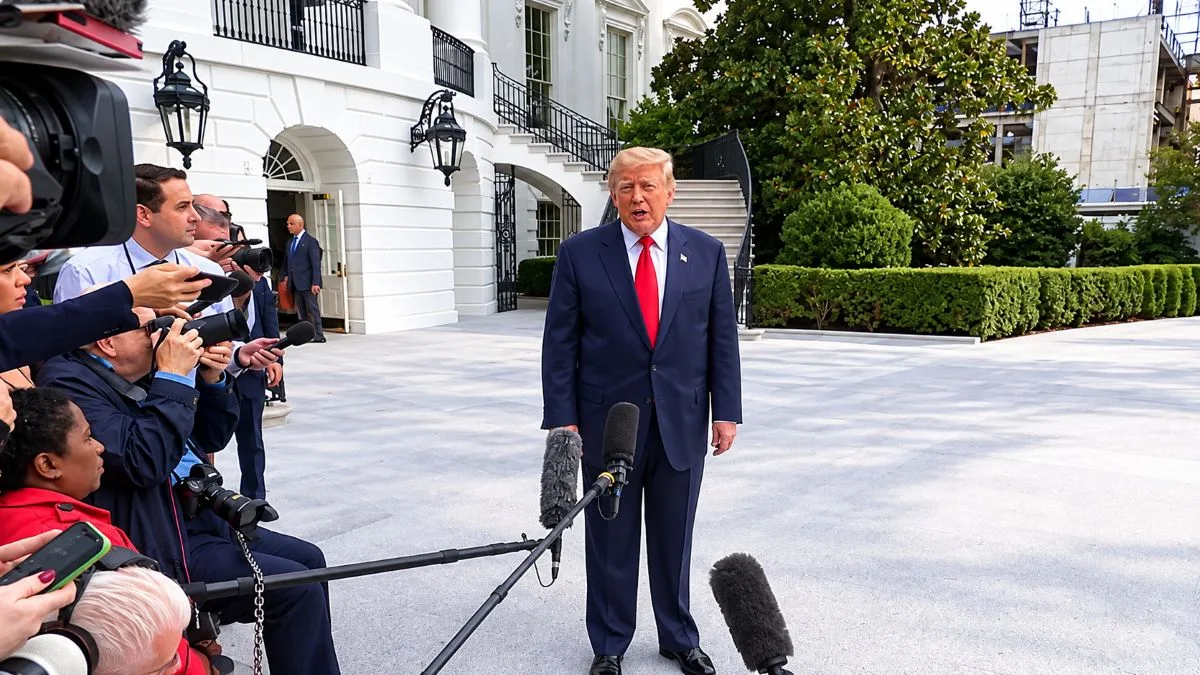
Donald Trump has spent years treating the trade deficit as one of the clearest scoreboards in American economic policy.
In August, that scoreboard moved sharply in the wrong direction.
The U.S. goods-and-services trade deficit widened 13.7% to $105.6 billion, according to the Bureau of Economic Analysis and the Census Bureau. Imports rose to a record $420.8 billion while exports increased much less, to $315.2 billion.
For an administration that has imposed sweeping tariffs partly to reduce America’s dependence on foreign goods and narrow persistent trade gaps, the number is politically awkward.
It is also easy to misuse.
The same government report shows that the year-to-date deficit through August is still 19.9% lower than during the same period in 2025.
That means August is neither proof that Trump’s tariff strategy has failed nor a number the White House can simply wave away.
It is a contradiction worth understanding.
The Headline Number Is Bad for the Administration
Tariffs are designed to make imported goods more expensive and, in theory, encourage buyers to shift toward domestic production or alternative suppliers.
If that process is working cleanly, one might expect imports to weaken and the trade deficit to narrow.
August did the opposite.
Imports jumped by $17.2 billion from July while exports rose by only $4.5 billion. The goods deficit widened to $136.6 billion, partially offset by a $31 billion services surplus.
The optics are especially difficult because imports did not merely rise. Several categories reached records.
Capital-goods imports climbed to an all-time high. Imports from Mexico and Vietnam also set records, according to the Census Bureau.
That gives Trump’s critics an obvious argument: after all the tariff disruption, America is still buying extraordinary amounts from abroad.
THE INSIDE READ
The deeper problem for the White House is that tariffs are colliding with another administration goal: strong investment.
Reuters reported that part of the import surge reflects businesses replenishing depleted inventories and buying capital goods, including equipment associated with the build-out of artificial-intelligence infrastructure.
That matters because not every import is evidence of American economic weakness.
A company importing advanced machinery to build a U.S. data center may widen the trade deficit today while increasing domestic productive capacity tomorrow.
Likewise, a manufacturer may import components because no equivalent domestic supplier can immediately deliver the volume, price or technical specification required.
Tariffs can change those decisions over time.
They cannot instantly rebuild every supply chain.
That is why the same monthly report can simultaneously look bad for Trump’s trade rhetoric and less alarming for the underlying economy.
The Year-to-Date Number Complicates the Attack
Anyone declaring the tariff strategy dead from one month has to contend with the broader comparison.
Through August, the U.S. trade deficit was down $138.2 billion from the same period in 2025, a decline of 19.9%.
Exports were up substantially on the year, while imports had risen at a slower pace.
That does not prove tariffs caused the improvement. Trade balances move with exchange rates, energy prices, economic growth, inventory cycles, consumer demand and business investment.
But it does mean August is a reversal inside a more complicated trend rather than a simple collapse of the administration’s policy.
Why the Deficit Can Widen Even Under Heavy Tariffs
Tariffs change prices. They do not erase demand.
If U.S. consumers and businesses are spending aggressively, they may continue buying imported goods even after those goods become more expensive.
Companies can also accelerate purchases before new duties take effect, creating temporary import spikes. Others may shift sourcing from one country to another rather than bringing production back to the United States.
That is one reason record imports from Mexico and Vietnam deserve attention.
A tariff regime aimed at one set of countries can redirect trade through other supply chains without reducing the total amount Americans import.
The policy can therefore change the map of trade before it changes the size of the deficit.
Canada Shows How Timing Can Distort the Picture
Canada’s August data offers a useful mirror.
Canadian exporters rushed shipments into the United States before a new round of U.S. tariffs took effect, helping push Canada’s monthly trade surplus sharply higher.
That does not mean the tariffs improved Canada’s long-term trade position.
It means businesses moved faster because a deadline was coming.
The same kind of timing effects can make monthly U.S. data unusually volatile. Imports brought forward into one month can disappear from the next. Inventories can be rebuilt and then pause.
September and October will therefore matter more than any attempt to turn August into a final judgment.
The Political Problem Is Simpler Than the Economic One
Economists can explain inventory cycles and capital-goods investment.
Campaigns work with much shorter sentences.
Trump has repeatedly presented the trade deficit as evidence that other countries are taking advantage of the United States. That framing makes a $105.6 billion monthly deficit difficult to separate from his own standard of success.
The White House can point to the better year-to-date number, new investment and the possibility that tariffs need more time to reshape supply chains.
Opponents can point to record imports and ask why the gap is widening after so much disruption.
Both arguments contain pieces of the truth.
THE SIGNAL
Watch the composition of imports, not just the total.
If consumer-goods imports keep surging, that would suggest tariffs are doing little to reduce American demand for foreign products.
If capital-goods imports remain elevated while domestic investment expands, the trade deficit may be reflecting an investment boom as much as a failure of trade policy.
Also watch whether import growth continues migrating toward countries that face lower effective barriers. That would show businesses adapting around tariffs rather than abandoning foreign supply chains.
WHAT HAPPENS NEXT
The next U.S. trade report is scheduled for November 4, one day after the midterm elections.
That timing means voters will not see another full monthly scoreboard before they vote.
Businesses, meanwhile, will continue adjusting to tariff changes already in place and preparing for whatever new negotiations or exemptions follow.
The policy experiment is still moving faster than the data can cleanly measure it.
THE INSIDER BOTTOM LINE
Trump built much of his trade politics around a simple proposition: America should buy less from abroad, sell more overseas and stop running enormous deficits.
August produced the opposite headline.
But the real story is not that tariffs suddenly failed. It is that the American economy is large enough, integrated enough and investment-hungry enough to resist simple scorekeeping.
A $105.6 billion deficit is a political contradiction for Trump.
Whether it becomes an economic indictment will depend on what the next several months reveal about where those imports are going, what they are financing and whether the broader trade gap keeps narrowing or starts widening again.

Leave a Reply