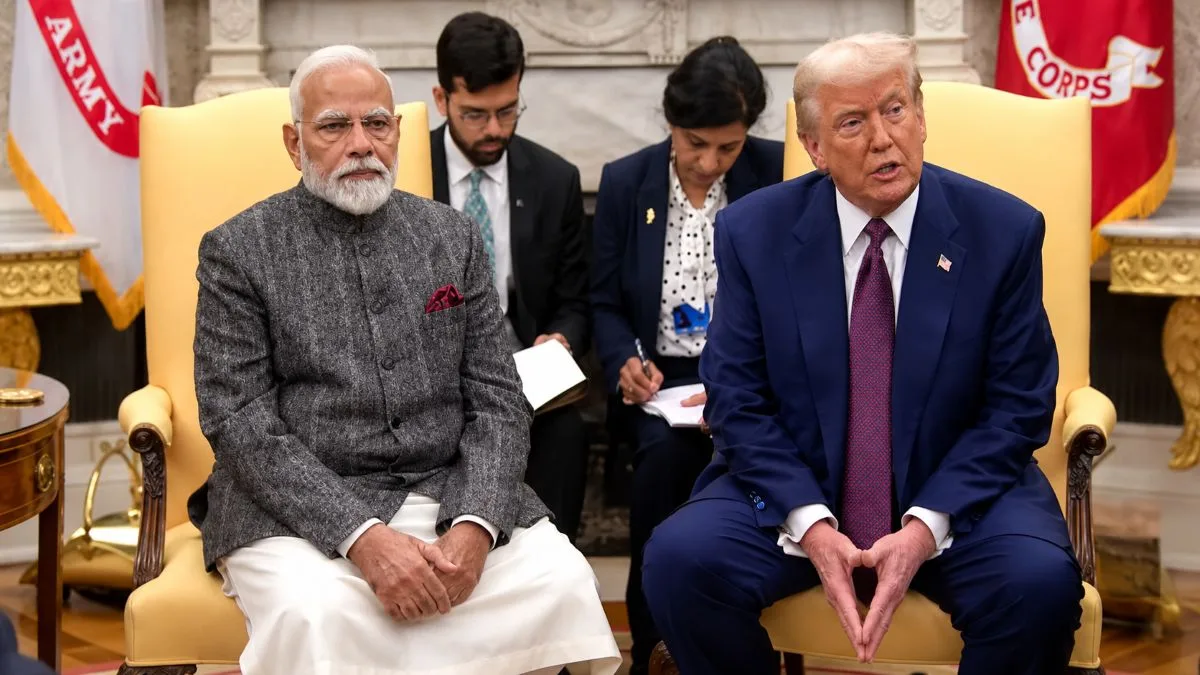
Donald Trump’s tariff strategy works best when the target believes the cost of resistance is greater than the cost of compliance.
India is testing that assumption.
Washington and New Delhi appeared to make major progress earlier this year when they reached a framework that reduced U.S. tariffs on Indian goods from the extraordinary 50% level to 18%.
The expected final agreement has not followed.
Instead, the negotiation has become entangled with Russian oil, agriculture, industrial overcapacity, regional security and a more fundamental disagreement about what the United States is entitled to demand from a strategic partner.
This is no longer merely a trade negotiation.
It is a negotiation over autonomy.
THE INSIDE READ
The United States has a powerful hand.
America is India’s largest export market. Indian companies benefit enormously from access to U.S. consumers, and key sectors including pharmaceuticals and smartphones have so far avoided some of the harsher tariff exposure that could still emerge if negotiations fail.
Trump’s approach is to turn that market access into leverage.
The message is familiar: if another country wants favorable access to the United States, Washington expects reciprocal concessions.
But India is not approaching the negotiation as a smaller economy seeking permission to enter the American market.
It sees itself as a rising great power, a strategic counterweight to China and a country whose foreign-policy decisions should not be dictated by either Washington or Moscow.
That is where Russian oil becomes so important.
THE RUSSIAN OIL PROBLEM
Washington wants India to reduce its purchases of Russian oil. From the American perspective, the logic is straightforward: energy revenue helps sustain Moscow while the United States is attempting to shape the endgame in Ukraine.
From India’s perspective, the calculation is different.
Cheap and reliable energy matters to a huge developing economy. New Delhi also has a long history of resisting pressure to align completely with one geopolitical bloc.
If India changes its Russia policy because Washington threatens tariffs, the precedent reaches beyond barrels of oil.
It would suggest that access to the U.S. market can be used to alter Indian foreign policy in areas that New Delhi regards as sovereign strategic choices.
That is a concession Indian leaders may find more expensive politically than the tariff itself.
WHY WASHINGTON CANNOT PUSH WITHOUT LIMIT
Trump has leverage, but the United States has constraints too.
India is too important to treat as an ordinary trade adversary.
Washington wants deeper cooperation with India on China, technology, defense and Indo-Pacific security. American companies want access to the Indian market. U.S. policymakers have spent years encouraging India to move closer to the Western strategic orbit without demanding formal alliance.
A tariff fight that becomes a political humiliation for New Delhi could damage those goals.
That does not mean India can simply wait out Washington. The U.S. market is too valuable, and the threat of higher duties is real.
It means both sides are operating inside a zone where they can hurt each other without wanting a complete break.
THE SIGNAL
The stalled agreement is evidence that leverage has stopped being one-directional.
If this were only about tariff percentages, a deal would probably be easier.
The difficult issues are the ones that touch domestic constituencies and strategic identity: agriculture, energy sourcing and the principle that India decides its own relationships.
That is why new deadlines keep arriving without the expected final document.
WHAT HAPPENS NEXT
High-level diplomacy will matter more than technical trade talks from here.
Reuters reports that U.S. Secretary of State Marco Rubio is expected to engage India later this month, with Prime Minister Narendra Modi due to visit the United States in December.
Those meetings create room for a political bargain that trade negotiators alone may not be able to produce.
The most likely path is not total victory for either side. It is compartmentalization.
Washington may seek enough movement on Russian energy or market access to claim success. India may offer selective concessions while protecting the principle that its foreign policy is not for sale.
The danger is that Trump’s negotiating style rewards visible victories. India’s political culture strongly resists visible submission.
That makes face-saving architecture essential.
THE CHINA FACTOR SITS IN THE BACKGROUND
Every U.S.-India dispute carries a second negotiation that is rarely written into the tariff schedule: China. Washington has spent years encouraging India to serve as a larger economic and strategic counterweight to Beijing. That objective gives New Delhi leverage because American officials must consider not only the immediate value of a trade concession but the long-term cost of pushing India toward greater distance from the United States.
India understands that. It does not need to become pro-China to use the relationship as bargaining power. It only needs Washington to remember that an alienated India makes the Indo-Pacific strategy harder.
THE INSIDER BOTTOM LINE
Tariffs are powerful because they create pain.
They become less powerful when the concession being demanded is more politically expensive than the pain itself.
India is now testing where that line sits.
The answer will matter far beyond one trade agreement because every U.S. partner is watching the same question:
How much can Trump make market access cost before strategic partners decide they would rather absorb the pressure than surrender the principle?
Leave a Reply