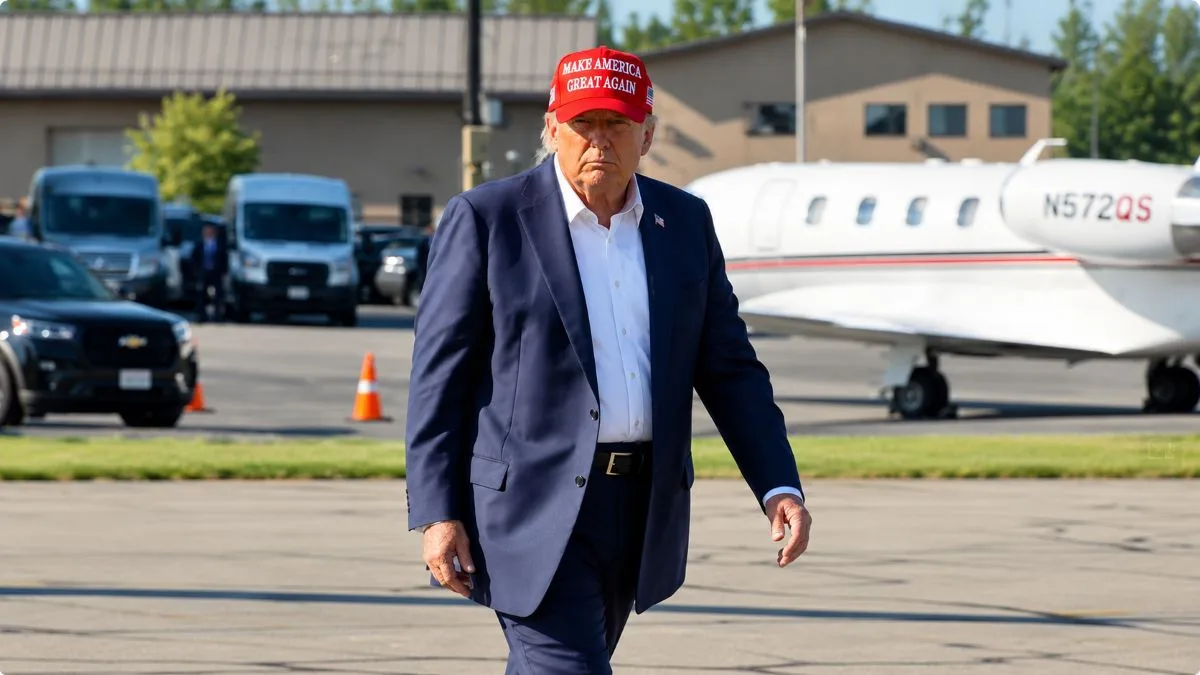
Donald Trump’s economic confrontation with Canada was always going to test Ottawa.
It is beginning to test Republicans at home too.
Canada’s retaliatory tariffs on roughly $20 billion worth of U.S. products took effect this week after trade negotiations between the neighboring countries broke down. Washington responded by widening the confrontation beyond conventional tariffs, including restrictions on certain Canadian products and pressure aimed directly at Canadian industry.
Then Trump threatened Bombardier.
That changed the politics.
Bombardier may be one of Canada’s most recognizable manufacturers, but its economic footprint does not stop at the border. The aerospace company employs roughly 3,500 people in the United States, including around 1,500 in Wichita, Kansas.
Suddenly, Republican senators from one of the most reliably Republican states in America were defending a Canadian company against a Republican president.
Senator Roger Marshall, who faces reelection, said he had taken concerns over Bombardier jobs directly into the Oval Office. Senator Jerry Moran separately contacted the administration to emphasize the company’s importance to Kansas. Republican Congressman Ron Estes has also defended Bombardier’s U.S. supply chain and opposed aerospace tariffs.
That is what economic integration looks like when political rhetoric meets a payroll.
Canada and the United States Built an Economy Across the Border
Trade wars are politically easy to describe.
One country sells goods to another. Tariffs make those goods more expensive. Domestic producers supposedly gain an advantage. Jobs come home.
Real supply chains are not that clean.
American and Canadian companies have spent decades building manufacturing systems that cross the border repeatedly.
A product can be designed in one country, use components made in another, employ workers on both sides and ultimately be sold around the world.
Bombardier illustrates the problem perfectly.
The company is Canadian, but its U.S. operations support thousands of workers. It also works with thousands of American suppliers across dozens of states.
Punishing Bombardier therefore does not only punish Canada.
It creates consequences inside the United States.
THE INSIDE READ
Trump’s larger strategy is based on leverage.
The American economy is dramatically larger than Canada’s. The United States is Canada’s most important trading partner. That gives Washington enormous capacity to impose costs.
The administration’s calculation appears to be that sufficient pressure will eventually force Ottawa to make concessions.
Canadian Prime Minister Mark Carney is pursuing the opposite political strategy.
Rather than absorb each threat quietly, his government has retaliated and increasingly framed the dispute as a question of Canadian economic sovereignty.
Canada’s latest tariffs hit hundreds of American products. The United States has answered with import bans on some Canadian goods scheduled to take effect later in September and restrictions involving large government contracts.
The question is no longer simply which side can impose greater pain.
It is which government can sustain the political pain that comes back across the border.
Kansas is an early example.
Trump’s Leverage Has a Domestic Limit
The White House can threaten Canadian exports.
It cannot guarantee that the economic consequences remain Canadian.
That is the weakness running through almost every trade war involving highly integrated economies.
American manufacturers need Canadian inputs.
Canadian companies employ American workers.
American farmers sell to Canadian consumers.
Canadian energy flows south.
American aircraft, vehicles, machinery and agricultural products travel north.
Trump’s leverage is enormous.
But it is not cost-free.
The Bombardier dispute has made that tradeoff visible because the jobs are concentrated enough for elected officials to feel immediate political pressure.
Marshall does not need an abstract debate about global trade.
He needs 1,500 Kansas workers to believe their livelihoods are secure.
The Midterms Make Everything More Dangerous
The timing adds another layer.
The United States is less than two months from midterm elections.
Republicans want voters focused on tax policy, immigration, border enforcement and what they consider the economic accomplishments of the Trump administration.
They do not want competitive races becoming referendums on local jobs threatened by a trade dispute initiated by their own president.
Democrats understand the opportunity.
Marshall’s Democratic opponent has already attacked the Bombardier threat by tying it directly to Kansas families.
That is how a foreign trade dispute becomes a domestic campaign advertisement.
Canada Is Trying to Reduce the Dependency
Carney’s longer-term response may matter more than the immediate tariff exchange.
Canada remains extraordinarily dependent on the American market, but there are signs of an effort to diversify.
The U.S. share of Canadian exports has declined compared with the previous year, while exports to non-U.S. markets have increased in some periods. Canada is also directing investment toward more domestic production, including a major plan to build VIA Rail passenger cars in Canada rather than relying on production abroad.
The numbers still show how difficult diversification will be.
Economic geography is powerful.
The United States is next door.
But every escalation gives Canadian policymakers another reason to reduce exposure.
That could eventually produce the opposite of what Washington wants: less Canadian dependence on U.S. suppliers and a weaker version of the deeply integrated North American economy that American businesses also benefit from.
THE SIGNAL
Watch Republican lawmakers from states with Canadian-linked manufacturing.
Kansas will not be the only potential pressure point.
If senators and House members begin publicly seeking exemptions for particular industries, companies or products, that will show where the administration’s broad trade strategy is colliding with local political reality.
The more exemptions Washington needs, the harder it becomes to maintain the argument that a sweeping confrontation is economically simple.
WHAT HAPPENS NEXT
The next U.S. restrictions on Canadian products are scheduled to take effect later in September.
Bombardier customers, aerospace suppliers and lawyers will also be watching whether Trump’s threat against the company becomes actual regulatory action or remains negotiating pressure.
Meanwhile, Ottawa and Washington must eventually decide whether this confrontation is a temporary bargaining tactic or a genuine restructuring of the economic relationship created under decades of continental integration.
THE INSIDER BOTTOM LINE
Trump has the larger economy and therefore the larger weapon in a trade confrontation with Canada.
But Canada has something Washington cannot fully neutralize: deep integration with American workers, suppliers and political constituencies.
Bombardier is demonstrating the problem.
It is possible to hit Canada economically and discover that part of the blow lands in Kansas.

Leave a Reply